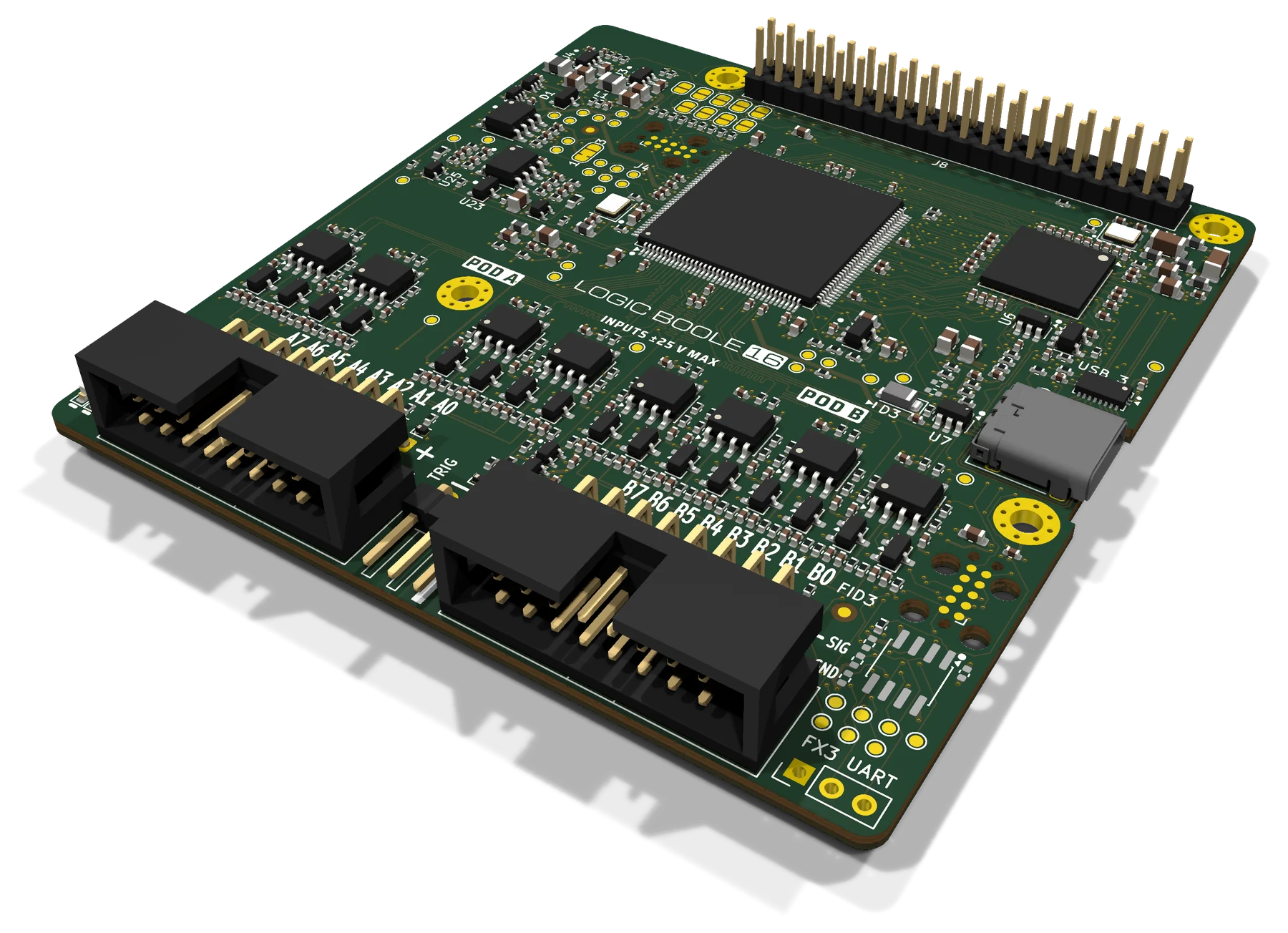
Logic Boole 16
An open-source 16-channel logic analyzer on USB 3. It runs from one USB-C cable on a computer, or sits on a Raspberry Pi 4 or 5 as a HAT+.
Open-source hardwareThe schematic, the board layout, the FPGA design, the firmware and the software are all published under open licenses: read them, change them, build your own. What is openFirst-batch price, one time only. The first four boards are $99. After that the board is $149.
Ships in the United States only. Shipping and any sales tax are added at checkout. Payment is taken by Stripe: this site never sees your card. Shipping and returns
In the box
- The board, assembled, with its headers soldered on
- USB-C cable: not included. Use one made for USB 3
- Spacers and screws for a Raspberry Pi: not included. It takes 4 × M2.5 × 16 mm spacers and 8 × M2.5 × 6 mm screws
- Probe leads: not included
What it does
Measured with 3.3 V signals unless markedA trigger in the FPGA
The trigger runs on every sample at the full rate: edges, levels, pulses by their length and levels that have lasted, with up to four stages in turn. A trigger input lets another instrument start the capture.
Each channel has a glitch filter up to 1.25 µs in 5 ns steps, and a capture can sample on your circuit's own clock up to 50 MHz.
It streams as it samples
Samples go to the host over USB 3 as they are taken, so a capture's length is set by the host's memory. The longest capture so far is 600 million samples.
All 16 channels stream at 100 MS/s for any signal, and at 200 MS/s for signals that change in up to 96 million samples a second.
Find your way around
Everything you plug into is on an edge- 140-pin stacking headerThe Pi's pins pass through to the top
- 2Pi bus jumpersOptional: tap the Pi's I²C, SPI and UART
- 3Power from USB or the PiIdeal diodes. It never feeds the Pi
- 4A threshold for each pod0.3–3 V, pod A and pod B set separately
- 516 fast comparatorsHysteresis on every channel
- 6Status LEDsPower, armed, triggered
- 7Pod A: channels A0–A7Keyed, a ground beside every signal
- 84 × M2.5 mounting holesOn the Pi's pattern, for M2.5 spacers
- 9Infineon FX3USB 3 at 5 Gbit/s, USB 2.0 as a fallback
- 10Spartan-6 FPGASamples at 200 MS/s, triggers in hardware
- 11USB-CPower and data on one cable, either way up
- 12Inputs rated ±25 VDivider, clamp and ESD diode on each
- 13Trigger in and out3.3 V logic. The input tolerates 5 V
- 14Pod B: channels B0–B7Its own threshold: two logic levels at once
The software
macOS and Linux. Not Windows
The app
Opens in your browser: waveforms, a threshold for each pod, the trigger, and decoders for I²C, SPI and serial that it can find by itself.
Command line and Python
Capture to a file for PulseView, a waveform viewer or a spreadsheet. Run any of sigrok's decoders on a capture. Commands print JSON for scripts.
AI agents
An agent can use the board by itself, through the command line with a skill file or through a Model Context Protocol server.
# Check the computer and the board
./logicboole check

# Wait for B0 to fall, and keep the millisecond after it
./logicboole capture reset.sr --rate 200M --time 1ms --trigger "B0=f"

# What a protocol decoder finds in a saved capture
./logicboole decode bus.lb16 i2c scl=A1 sda=A0
On a Raspberry Pi
A HAT+ for the Pi 4 and Pi 5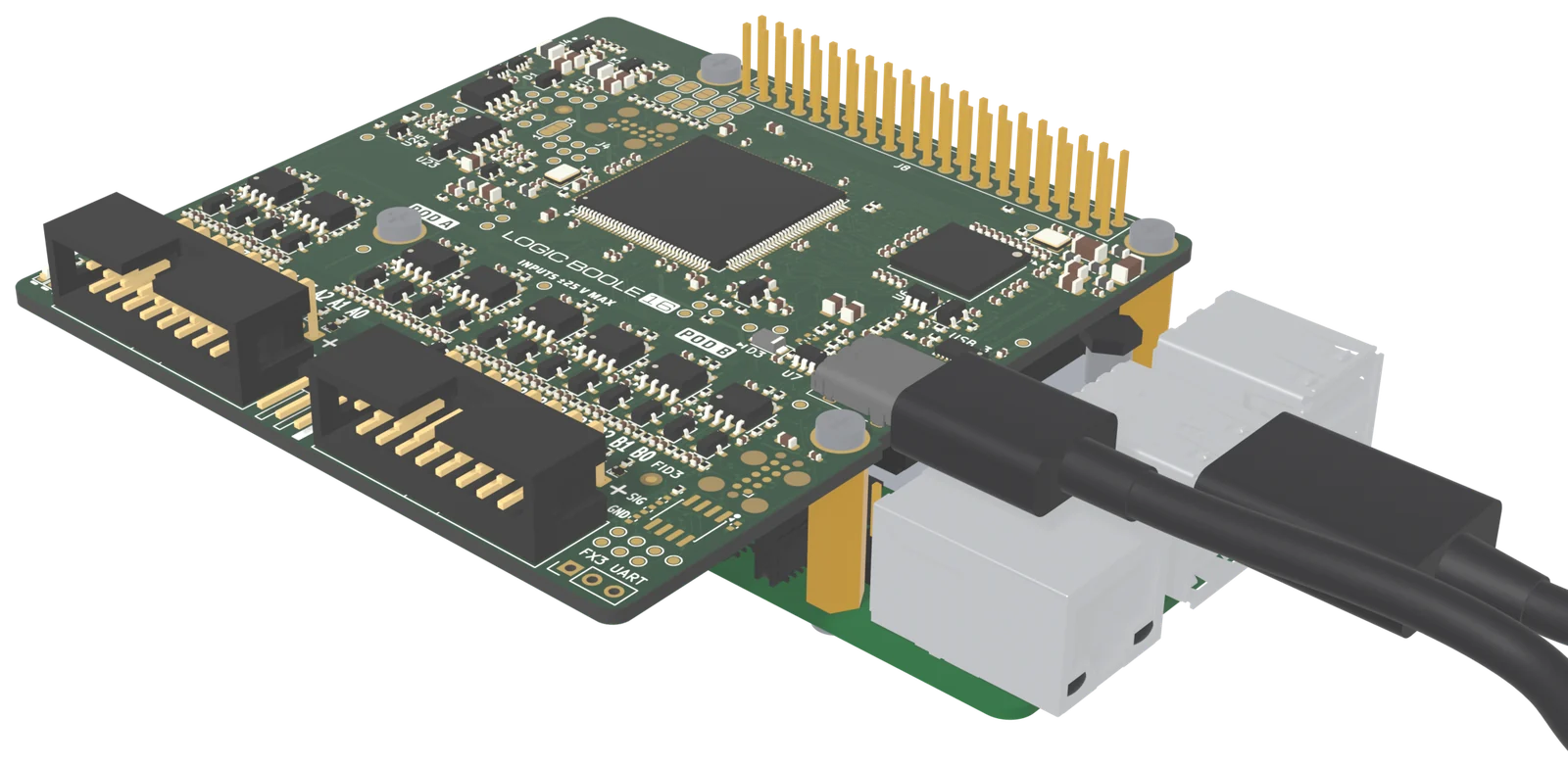
- Stack another HAT on top. As shipped the board connects to none of GPIO 2 to 27, and all 40 pins pass through.
- Powered by either side. It runs from the Pi's 5 V pins, from USB-C, or both, and never feeds power back into the Pi.
- Capture the Pi's own buses. Close solder jumpers, and a capture can take the Pi's I²C, UART and SPI lines in place of pod channels.
- Room for the Active Cooler. The board sits 16 mm above the Pi, and nothing but the header is fitted underneath.
Specifications
Board revision C · datasheet revision CCapture
| Channels | 16 digital, in two pods of 8 |
|---|---|
| Sample rate | 200 MS/s, or 200 MS/s divided by a whole number |
| Streaming, USB 3 | Raw: 16 channels at 100 MS/s, any signal. Run-length: 16 channels at 200 MS/s, for signals that change in up to 96 million samples a second |
| Fastest signal | Clocks up to 85 MHz, pulses down to 6 ns |
| Before the trigger | The newest 8184 words: 16,368 samples in the raw format |
| Trigger header | TRIG IN, and TRIG OUT 75 to 80 ns after the trigger sample |
| Glitch filter | For each channel, from off to 1.25 µs in 5 ns steps |
| Capture clock | The circuit's own clock, up to 50 MHz |
Inputs, link and board
| Logic levels | 1.2 to 5 V |
|---|---|
| Thresholds | 0.3 to 3.0 V in 0.75 mV steps, one for each pod |
| Channel skew | 1.4 ns between the earliest and the latest of the 16 inputs of one board |
| Maximum input | ±25 V |
| Host link | USB-C. USB 3 at 5 Gbit/s; USB 2.0 works and carries a ninth as much |
| Power | 5 V from USB-C or the Pi's header, about 1 W |
| Main parts | Spartan-6 XC6SLX9 FPGA, Infineon EZ-USB FX3, 16 fast comparators |
| Size | 82 × 86 mm, four layers, parts on the top side only |
Open hardware
Read it, change it, build your ownOne repository holds the whole of board revision C: the KiCad project and the files the boards were made from, the FPGA design in Verilog with its test benches, the firmware's source, and the host software.
The board keeps no firmware. The host loads it each time it connects, so nothing you load can brick it.
Good to know
Before you pack it- It needs a host. A computer or a Raspberry Pi loads the board every time it connects and holds the capture.
- Digital only. Sixteen logic inputs. No analog channels and no pattern generator.
- 200 MS/s needs idle time to stream. A signal that changes in 100 million samples a second or more overflows after 4.5 ms. Use the raw format at 100 MS/s for such signals.
- Thresholds stop at 3 V. That covers 5 V logic at the usual half-way point, 2.5 V.
- The inputs are not isolated. Their ground is the USB cable's ground and the Raspberry Pi's ground.
- The first load needs the internet. The software downloads the firmware image once, about 110 kB.
From the field guide
Near Field Notes: the notes behind this boardWhat do a chip fuse, a polyfuse and an eFuse do when a USB port shorts?
Read before you power a board from a laptop.
Note 13 · PowerWhich kind of capacitor should feed a load?
Six parts that store charge, each running the same load.
Note 47 · HistoryWho invented USB-C?
The connector every kit here plugs into.